

NOSIGNER Founder Eisuke Tachikawa Visits NCKU ICID: From Climate Adaptation to Evolutional Creativity in the Age of AI
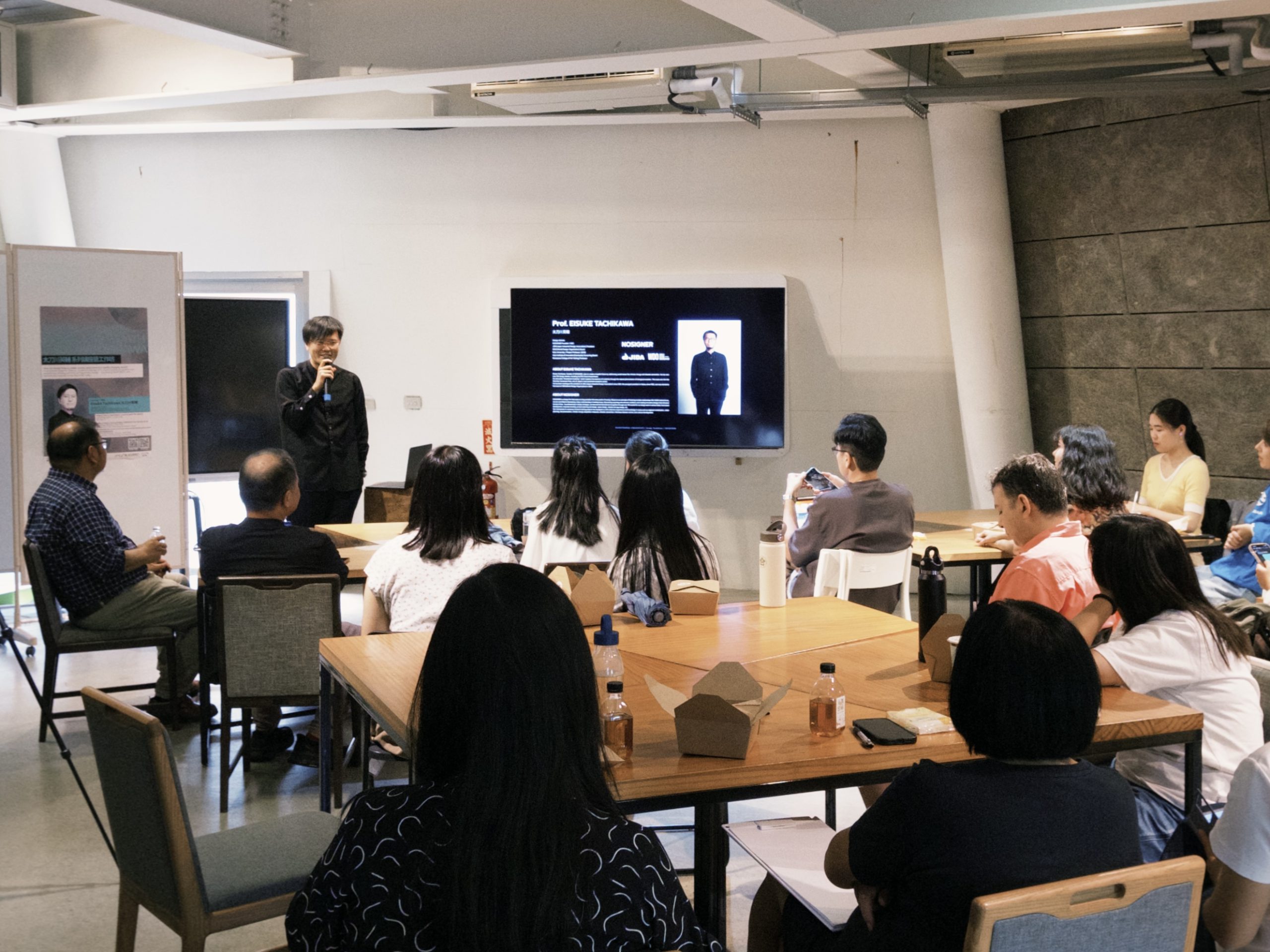
In September 2026, the Institute of Creative Industries Design (ICID) at National Cheng Kung University (NCKU) welcomed Japanese designer Eisuke Tachikawa. A board member of the World Design Organization (WDO) and founder and CEO of NOSIGNER, Tachikawa works across industrial design, graphic design, architecture and social innovation, using design to address disaster resilience, environmental change and complex social challenges. His methodology, Evolutional Creativity, draws on variation and selection in biological evolution to explore how creativity emerges and develops. His visit brought this approach, developed through design practice, into graduate teaching and academic exchange, connecting it with discussions on climate adaptation, urban systems, artificial intelligence and the future of creativity.
The series began with “ADAPTMENT: Climate Adaptive Design.” Drawing on adaptive mechanisms in nature, Tachikawa invited students to reconsider climate adaptation. Beyond seeking a single, fixed solution, he encouraged them to explore how cities and societies can function like living systems—observing, adjusting, learning and evolving in a continually changing environment. Through case studies and discussions across different scales, students re-examined the interconnected relationships among climate, cities, the environment and everyday life.
The subsequent two-day workshop focused on Evolutional Creativity. Participants explored different forms of “Variation” to expand possibilities, then applied “Selection” through observation, comparison, evaluation and refinement, gradually developing creative proposals through repeated iterations. The workshop also included experiments in AI collaboration, enabling students to test how Evolutional Creativity could work alongside generative artificial intelligence. These experiments raised a central question for contemporary design education and research: when AI can rapidly generate numerous possibilities, at which stages do human judgement, intention, values and choice remain indispensable?
The workshop built on the City Design Power programme led by Felix Kosok the previous week. Students first identified actors, resources, relationships and design challenges within Tainan’s urban systems, then brought these challenges into the Evolutional Creativity process for further development. Together, the two weeks formed a continuous learning journey titled “From Understanding the City to Reimagining the City,” moving from an understanding of existing urban systems towards the generation of possible responses and future directions.
Through this international series, ICID brought design practitioners who are actively developing new methods and addressing contemporary and future challenges into direct dialogue with students and faculty. Beyond introducing methods and case studies, the programme sought to open up the boundaries between design practice and academic inquiry, allowing knowledge and approaches developed through practice to be applied, discussed, critically examined and extended within a university setting.
By integrating Tachikawa’s design methodology into ICID’s teaching and connecting it with Tainan’s local context, students’ observations and interdisciplinary discussions, the exchange opened further possibilities for sustained collaboration among design practice, higher education and research. For students, the experience went beyond exposure to international case studies: it offered opportunities to identify problems, build connections and develop responses to real-world challenges across different scales and from the perspectives of diverse stakeholders. For the methodology itself, the university served as a platform for continued testing, discussion and the deepening of knowledge developed through practice.
Spanning climate adaptation, urban systems, AI and creativity, Tachikawa’s visit offered more than a set of design tools. It introduced a way of understanding change: design involves continually observing uncertain environments, generating possibilities and making choices, while evolving through practice, teaching and exchange.

